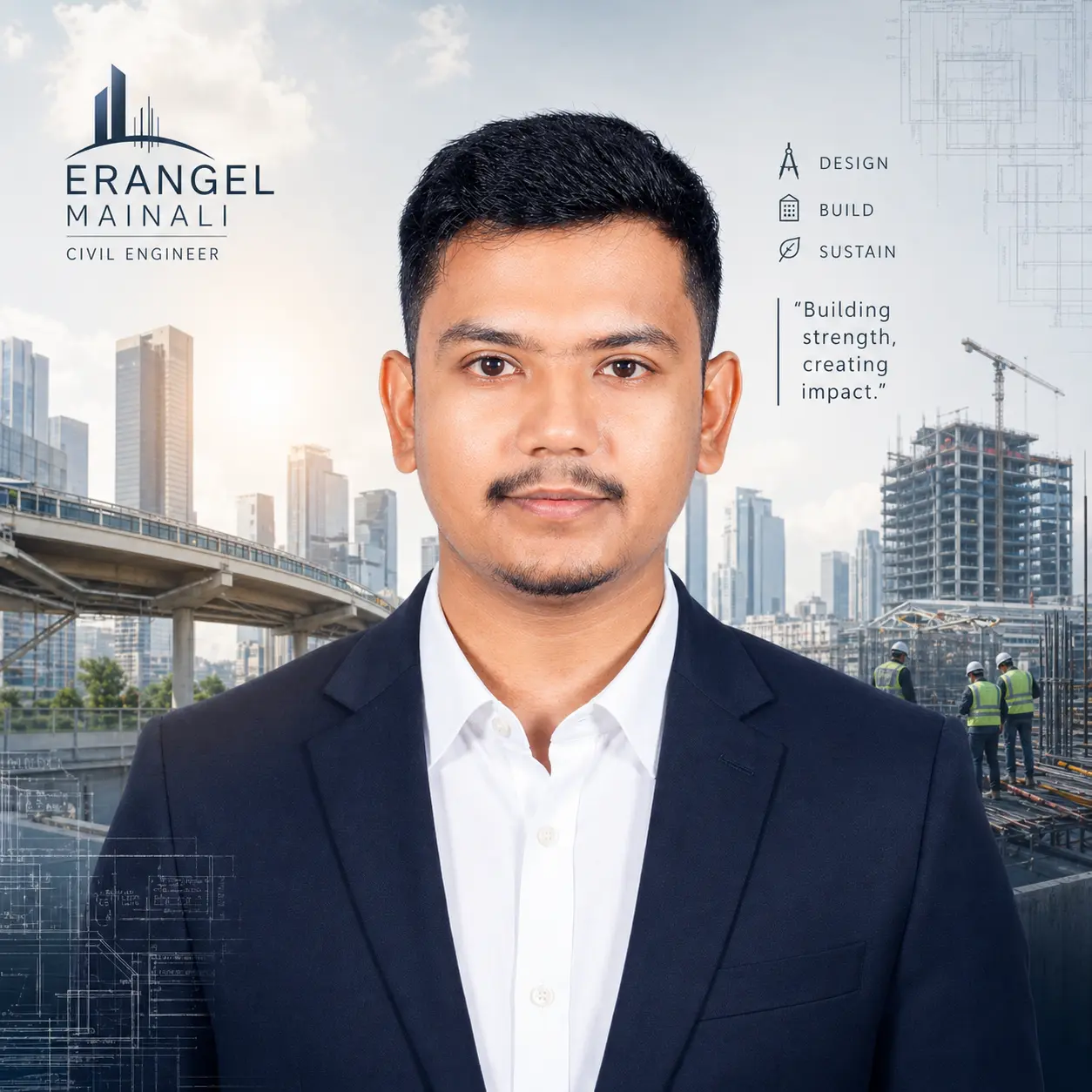
I bridge physical infrastructure execution with computational automation. Hydropower civil engineering, seismic assessment of heritage masonry, and the engineering software tools that make Nepal's design offices faster.
I'm Angel Mainali, a licensed Civil Engineer working at the seam between physical infrastructure and computational automation. I'm currently the Hydropower Engineering Researcher & Assistant on the Lower Karnali Hydropower Project with Gorkha Hydro & Engineering Pvt. Ltd., executing daily empirical data collection in highly dynamic fluvial environments and running cost–time trade-off analyses under deep uncertainty.
On the computational side, I architect full-stack web applications and algorithmic engineering tools that replace static, manual quantity takeoffs with dynamic stochastic models. AnchorBlock Pro on the Chrome Web Store automates the AEPC 10-Force method for penstock anchor block stability — what used to take hours of spreadsheet trigonometry now finishes in seconds, with verified PDF reports.
My academic work has been twice peer-reviewed in 2025–26: a paper on WASH infrastructure resilience in Water Practice & Technology (IWA Publishing), and a non-linear pushover analysis of traditional masonry buildings in Patan in the Journal of Engineering Issues and Solutions. Both papers used DIANA FEA and field survey data to inform real seismic retrofitting decisions for Nepal's heritage zones.
I'm available for consulting in hydropower, structural assessment, and computational engineering — and for research collaboration on hydroinformatics and seismic vulnerability of historic Nepali architecture.
Day-rate, project-based, or retainer. I work with NGOs, development agencies, hydropower developers, municipalities, and private consultancies. Remote-first, with on-site availability across Nepal.
Penstock alignment design, anchor block stability verification (AEPC 10-Force method), powerhouse structural support optimisation, and on-site empirical validation for run-of-river schemes.
Custom calculators, AutoLISP libraries that automate AutoCAD drafting (GLs, L-sections, cross-sections), full-stack web tools, and LLM-integrated compliance workflows. Built specifically for Nepal's AEC offices.
Non-linear pushover analysis using DIANA FEA, fragility curve generation, capacity spectrum verification against NBC 105:2020, and retrofitting strategy for masonry and RC structures — including heritage buildings.
Stochastic construction cost models tuned to Nepalese supply chain data, district-wise rate analysis, and dynamic BOQ generation. Powered by my own Zila platform with regional rate processing.
Water supply and sanitation system design, post-disaster resilience assessment, and WASH programme technical support for NGOs and municipalities — informed by my IWA-published research on Nepal's vulnerability profile.
Open to co-authorship on hydroinformatics, seismic vulnerability of heritage architecture, and applied computational engineering. Comfortable with empirical fieldwork and finite-element modelling pipelines.
Built from real field-work pain points. Two are live on the Chrome Web Store, one is open-source on GitHub, others are in active development. Coming soon: a marketplace for AutoLISP routines and Nepal-specific design utilities.
Headrace & penstock anchor block stability analyzer. Automates the AEPC 10-Force method — sliding, overturning, and bearing capacity checks — replacing tedious spreadsheets with instant, mathematically flawless analysis directly in your browser.
Chrome extension that streamlines Nepal property and land record workflows. Built to compress hours of repetitive Lalpurja and parcel work into seconds, with district-aware logic across the Federal Democratic Republic's geography.
Full-stack stochastic construction cost estimation platform (TypeScript · Next.js · Supabase). Processes dynamic regional supply-chain data to automate complex takeoffs for the Nepalese market across 50+ districts.
Browser extension that uses LLM APIs to parse and automate civil regulatory compliance workflows — checking submissions against NBC, building bylaws, and design code requirements before they land on a reviewer's desk.
Extensive set of automated drafting routines that run directly inside AutoCAD — instant ground level (GL) calculation and plotting, L-section and cross-section generation, and pier alignment verification. Marketplace listing planned.
Mobile-first HSE checklist and audit tool for active construction sites. Generates field reports aligned with Nepal Labour Act requirements and standard international HSE frameworks, with offline-first sync.
Nepal's traditional masonry buildings — particularly in UNESCO World Heritage zones like Patan — are seriously threatened by high seismicity and pre-code construction (unreinforced brick with mud mortar). This study fills a critical gap in Nepal's seismic risk models by performing three-dimensional non-linear pushover analysis on a typical traditional brick building using DIANA FEA 10.5, calibrated against laboratory compressive strength tests and field surveys. Fragility curves across four damage states are mapped to roof displacement, and Capacity Spectrum Method analysis against NBC 105:2020 demand spectra reveals collapse-prevention thresholds being exceeded at PGA values as low as 0.1g. The output is region-specific fragility and capacity data to inform retrofitting and heritage conservation planning.
Examines the vulnerability of Water, Sanitation, and Hygiene (WASH) infrastructure in Nepal to seismic and flood events, drawing on field data from post-disaster assessments across multiple districts. Proposes a resilience framework for designing sanitation systems that remain functional in the immediate aftermath of natural disasters common to the Himalayan region — directly informing engineering design standards and humanitarian response planning. Published open access in Water Practice & Technology (IWA Publishing).
Whether you're scoping a hydropower feasibility, planning a WASH programme, or assessing seismic vulnerability of a heritage structure — I'd like to hear about your project. Day-rate, project-based, or retainer arrangements all work.
Thanks for reaching out. I'll be in touch within 1–2 working days.